
What’s all the fuss about, anyway?
Simply put, “BESS” is an acronym. It stands for Battery Energy Storage System. A BESS facility doesn’t generate energy—it merely stores it. That’s why it must connect to a substation like the one near 400 E. and 800 S. outside of Markleville. Its purported goal is to improve the reliability, stability, and resiliency of the regional power grid.
But the side effects—both guaranteed and potential—lead us to believe that a BESS facility isn’t a good choice for our community.
To the casual observer, a BESS looks like a series of metal shipping containers. Each container holds toxic lithium. Initial renderings show well over 200 of these containers slated for the BESS in our neighborhood.
That’s a lot of toxic material in our backyard.
Near our wells. …A stone’s throw from our schools. …Close to our families, our friends, and our houses of worship.
Even if there’s never a fire, an accident, or a damaging storm, we believe a BESS facility in our community is a bad idea.
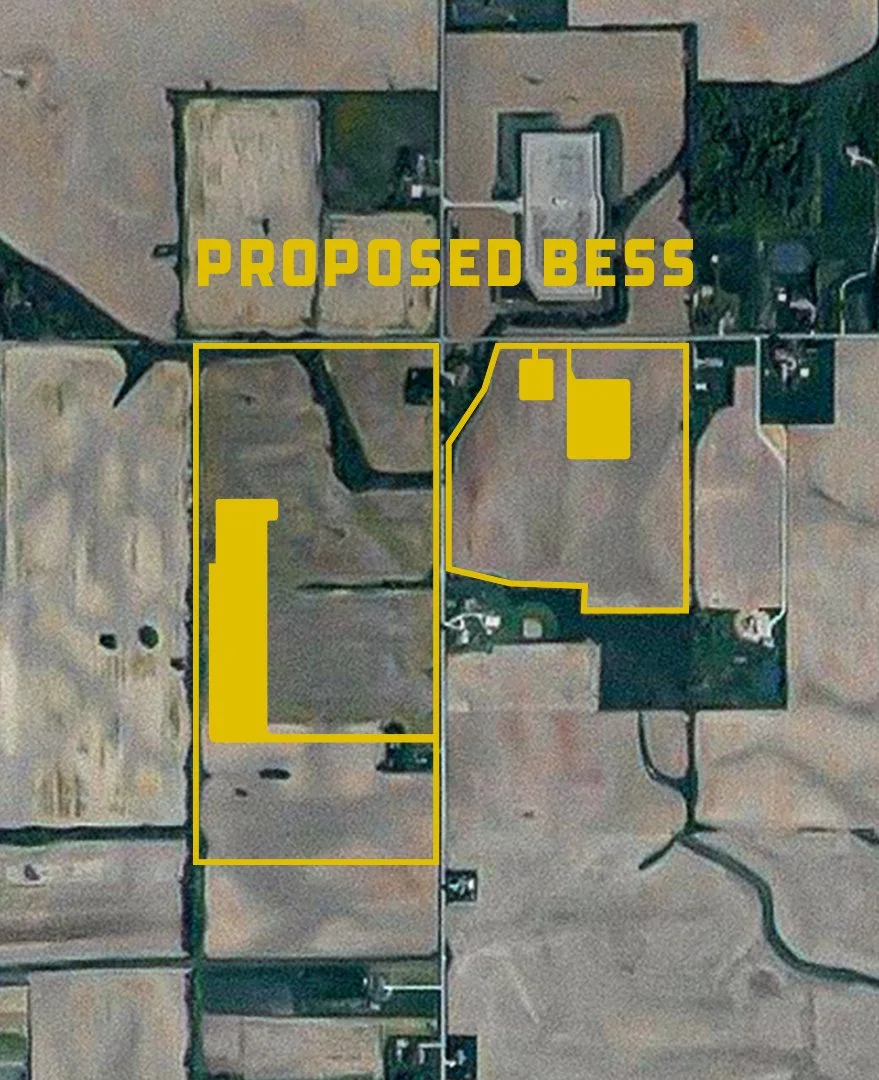

But what if things did go wrong?
One of the most concerning dangers of BESS facility is the prospect of a fire. A BESS fire spews deadly toxic chemicals into the air. What’s more, a BESS fire can’t be extinguished. They’re simply left to burn out. And that can take days.
Imagine the potential effects on our property values, quality of life, and our health.
And the upside? A mere four hours’ worth of battery backup power for people who don’t even live in our community. Seems like a mess, doesn’t it?